
The latest phase of the Trump Administration’s Revolutionary Federal Acquisition Regulation (FAR) Overhaul (RFO) makes federal procurement faster, simpler, and more like the commercial marketplace. For agencies, it means fewer process bottlenecks. For businesses, especially small firms, it means clearer rules, quicker awards, and a more level playing field.
Announced on August 14, 2025, this coordinated package of six model deviations plus one General Services Administration Acquisition Regulation (GSAR) change marks the “commercial tranche” of the RFO. These updates are designed to align federal buying with the way the private sector operates, while maintaining the safeguards needed to protect taxpayer dollars and the integrity of the supply chain.
How This Fits the Administration’s Strategy
These changes are not just edits to the FAR. They are a direct extension of the Administration’s One Government (OneGov) modernization agenda. Launched under Executive Order (EO) 14275 and guided by Office of Management and Budget (OMB) Memorandum M-25-26, the RFO is the backbone of the Administration’s procurement reform plan.
The goals are clear and practical:
- Streamline processes by removing non-statutory and duplicative requirements.
- Encourage commercial solutions to expand competition and drive better value.
- Maintain strong security safeguards in a simpler, more accessible format.
- Empower acquisition professionals by involving them directly in shaping the rules.
The commercial tranche advances each of these priorities, especially the push to expand both the defense and civilian industrial base and strengthen America’s supply chain security.
Key Changes at a Glance
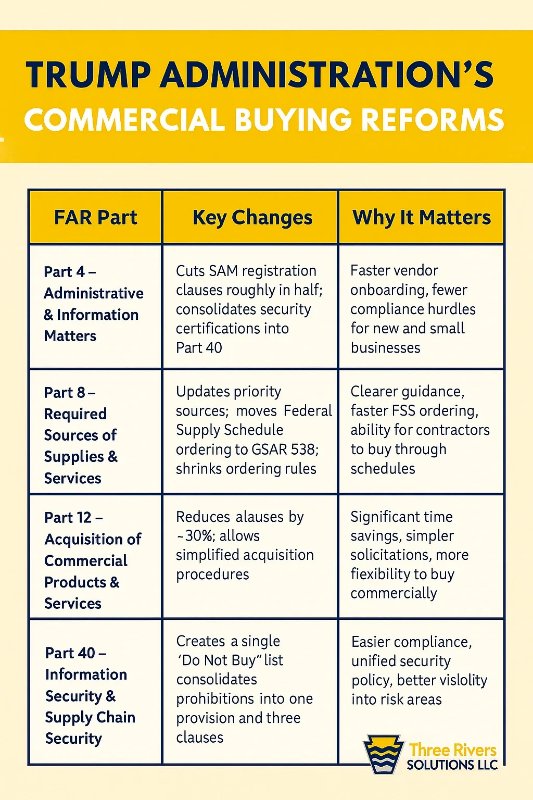
Part 4 – Administrative and Information Matters Key Changes: Cuts System for Award Management (SAM) registration clauses roughly in half once information technology updates are complete; consolidates security and supply chain certifications into one streamlined process (now in Part 40); reorganizes by acquisition lifecycle. Why It Matters: Faster vendor onboarding and fewer compliance hurdles for new and small businesses.
Part 8 – Required Sources of Supplies and Services Key Changes: Updates priority sources in line with Office of Management and Budget (OMB) Memorandum M-25-31; keeps AbilityOne prominence; moves Federal Supply Schedule (FSS) ordering to General Services Administration Acquisition Regulation (GSAR) 538; shrinks ordering rules from 27 pages to 7. Why It Matters: Clearer guidance, faster FSS ordering, and the ability for contractors to buy through schedules to deliver full solutions.
Part 12 – Acquisition of Commercial Products and Commercial Services Key Changes: Reduces clauses by about 30 percent; explicitly allows simplified acquisition procedures (SAP) for commercial buys up to $7.5 million ($15 million in emergencies); encourages request for quotation (RFQ)-based comparative evaluation; permits construction under Part 12. Why It Matters: Significant time savings, simpler solicitations, and more flexibility to buy commercially.
Part 38 – Reserved Key Changes: Removes duplicative FSS contracting rules; content moved to GSAR 538 and Part 8. Why It Matters: Eliminates redundancy and centralizes guidance in one place.
Part 40 – Information Security and Supply Chain Security Key Changes: Creates a single “Do Not Buy” list; consolidates seven statutory prohibitions into one provision and three clauses; covers Kaspersky, Section 889, TikTok, Federal Acquisition Supply Chain Security Act (FASCSA), Office of Foreign Assets Control (OFAC) bans, unmanned aircraft, and safeguarding rules. Why It Matters: Easier compliance, unified security policy, and better visibility into risk areas.
Part 51 – Reserved Key Changes: Moves “use of government sources by contractors” rules to Part 8.105 with updated clauses. Why It Matters: Less fragmentation and all related content in one location.
Action Items for Contractors
- Update solicitation templates to remove eliminated clauses and insert the new ones from the model deviations to avoid compliance gaps.
- Leverage simplified acquisition procedures for eligible commercial buys up to $7.5 million; use RFQs to speed awards and reduce administrative burden.
- Replace outdated security clauses with the unified Part 40 set for clearer and more consistent compliance.
- Streamline Federal Supply Schedule work by following GSAR 538 for schedule ordering and using updated Part 8 priorities.
- Engage during the feedback period since informal comments are open until October 14, 2025.
Why These Changes Are Significant
This is a turning point in the FAR Overhaul. The commercial tranche shows that the Administration is not simply rewriting rules. It is rethinking how government buys. The result is a faster, clearer, and more accessible federal marketplace that supports the mission, promotes competition, and strengthens American industry.
For agencies, it means less time lost in process and more focus on delivering results. For contractors, it means fewer barriers to entry, simpler compliance, and more opportunities to compete.
What's Next
This is only the beginning. Additional FAR parts are already in the pipeline, and the formal rulemaking process will follow these model deviations. Agencies and contractors that move early will be best positioned to take advantage of the faster, clearer, and more competitive marketplace the Trump Administration is building.