
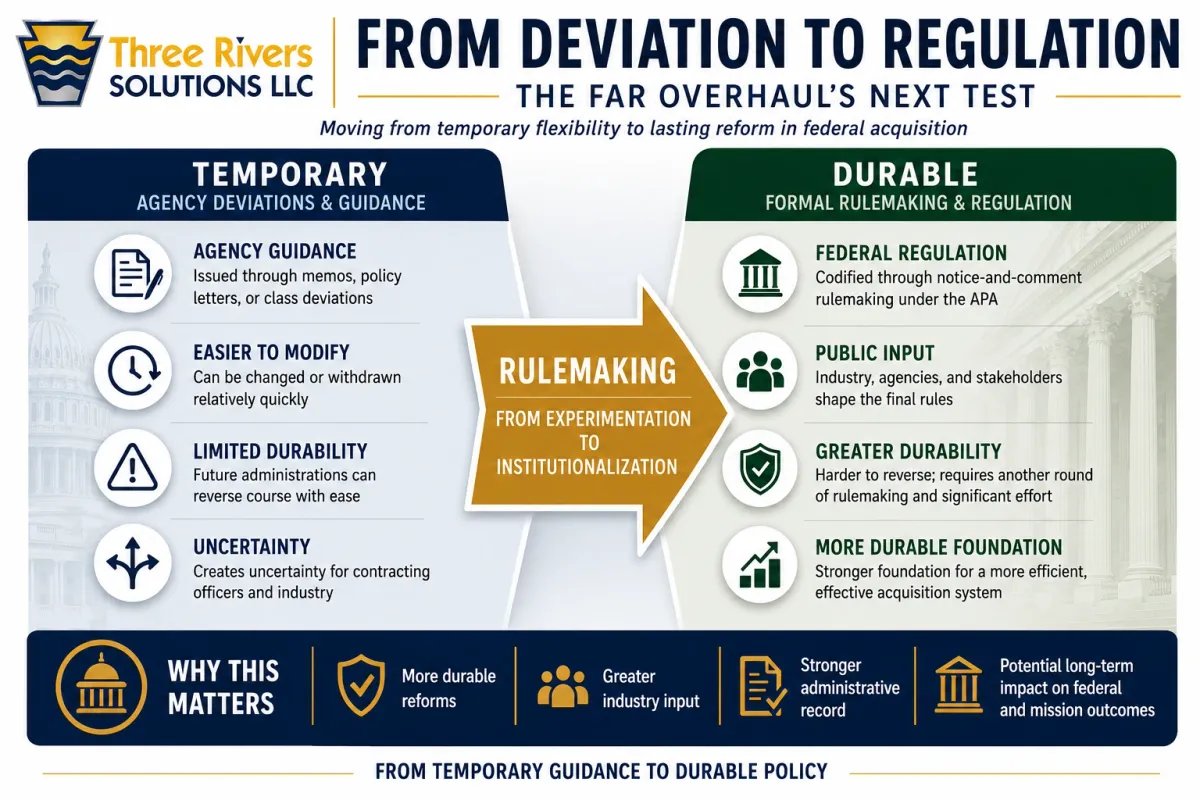
The Trump Administration’s effort to overhaul the Federal Acquisition Regulation (FAR) has entered a new and more consequential phase.
Earlier this year, the FAR Council began moving portions of the initiative into the formal rulemaking process. After spending the past year implementing elements of the overhaul through agency deviations and interim guidance, the administration is now seeking to codify key reforms through the FAR itself.
For supporters of procurement reform, this development represents more than a procedural milestone.
It is the first meaningful test of whether the administration’s vision for a leaner, less prescriptive acquisition system can withstand the scrutiny of the rulemaking process and become embedded within the long-term architecture of federal procurement.
From Temporary Flexibility to Regulatory Change
Much of the FAR overhaul has been implemented through acquisition deviations.
That approach allowed agencies to begin operating under revised policies without waiting for the often lengthy process required to amend the FAR itself. It also gave policymakers an opportunity to test concepts, identify implementation challenges, and gather feedback from acquisition professionals and industry.
The move into formal rulemaking changes the conversation.
Temporary guidance can be modified or withdrawn relatively quickly. Final regulations can also be revised by future administrations, but doing so generally requires another round of notice-and-comment rulemaking and a far greater investment of time and political capital.
The distinction is important because it signals that the administration is no longer focused solely on experimentation. It is attempting to institutionalize reform.
Why the Administration Is Pursuing Reform
The administration’s rationale is straightforward.
Federal procurement has become increasingly complex.
Over many decades, Congress, administrations of both parties, oversight bodies, inspectors general, courts, and agencies have added requirements intended to strengthen accountability, improve transparency, reduce risk, or advance public policy objectives.
Most of those requirements were adopted for legitimate reasons.
The challenge is that government is generally more effective at adding requirements than removing them.
Every review process, approval step, certification requirement, reporting obligation, or oversight mechanism may appear reasonable when viewed independently. Over time, however, those individual requirements accumulate. The cumulative effect can be a system that becomes slower, more difficult to navigate, and increasingly disconnected from the pace of technological and operational change.
That dynamic is not unique to procurement. It is a recurring challenge across government.
The administration’s argument is that the acquisition system has reached a point where simplification is necessary. The FAR overhaul seeks to reduce non-statutory requirements, rewrite portions of the regulation in clearer language, and provide contracting officers with greater flexibility to exercise professional judgment.
The administration deserves credit for addressing a challenge that acquisition professionals have debated for decades, even if some individual proposals are revised during the rulemaking process.
Procurement Reform Is Not a New Idea
Federal procurement reform did not begin with the current administration.
Efforts to modernize the acquisition system have emerged under administrations of both parties. Congress pursued significant reforms through the Federal Acquisition Streamlining Act and the Clinger-Cohen Act. More recently, the Section 809 Panel conducted an extensive review of defense acquisition regulations and proposed sweeping changes designed to improve efficiency and access to commercial innovation.
What makes the current initiative different is its scope.
Rather than focusing on a discrete set of reforms, the administration is undertaking a comprehensive review of the FAR itself. That approach creates greater implementation challenges, but it also creates the possibility of more significant change.
Why This Matters Beyond Procurement
Discussions about acquisition policy often remain confined to procurement professionals, contracting officers, and government contractors.
They should not.
The federal acquisition system influences how quickly agencies can modernize information technology systems, adopt emerging technologies, strengthen cybersecurity capabilities, respond to emergencies, and deliver public services.
When procurement processes become unnecessarily burdensome, the consequences extend beyond acquisition offices. Program delivery slows. Technology adoption becomes more difficult. Administrative costs increase. Agencies become less responsive to changing mission requirements.
In that respect, procurement reform is ultimately a government performance issue.
The effectiveness of the acquisition system has a direct impact on the effectiveness of government itself.
The Workforce Challenge
Regulatory reform alone will not determine the success of the FAR overhaul.
A less prescriptive acquisition system places greater responsibility on the federal acquisition workforce. Increased flexibility requires contracting officers who possess the experience, judgment, and institutional support necessary to make sound decisions in complex environments.
The administration is pursuing procurement simplification at the same time agencies are navigating workforce reductions, retirements, and broader organizational changes. Greater discretion can produce better outcomes, but only if agencies maintain a workforce capable of exercising that discretion effectively.
In fact, one of the strongest arguments for simplification is that a less burdensome regulatory framework may be easier for acquisition professionals to administer, particularly as agencies face ongoing workforce challenges.
For that reason, workforce readiness may prove just as important as regulatory reform in determining the initiative’s long-term success.
The Rulemaking Process Matters
The most consequential aspect of this development may not be any individual policy proposal.
It is the administration’s decision to move the overhaul into formal rulemaking.
The public comment process will give contractors, industry associations, and acquisition professionals an opportunity to build the administrative record supporting these reforms. Stakeholders with concerns about specific proposals will also weigh in, and some changes will be revised as a result. That is how the process is supposed to work, and a reform effort of this ambition should be able to withstand that scrutiny.
Those debates are both healthy and unavoidable when rewriting a regulatory framework that has accumulated requirements over decades.
Looking Ahead
What happens next depends significantly on how actively stakeholders engage.
Supporters of the initiative will have an opportunity to argue that the federal acquisition system has become overly complex and that greater flexibility is needed to improve government performance. Critics will argue that many existing requirements were adopted to address legitimate concerns and should not be removed without careful consideration.
Both perspectives will influence the final outcome.
For contractors, industry associations, and acquisition professionals, this is not a moment for passive observation. The rulemaking process offers a rare
opportunity to influence changes that could shape federal procurement for years to come.